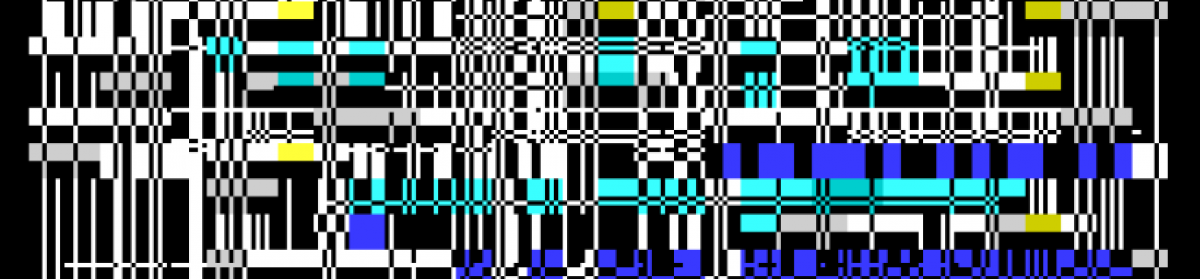
‘GLITCH’ DATA & CODE MASH-UP – CARRY ON COMPUTING
Sound on – warning – clicks, bleeps, shrieks. Geoff Davis: MA2 Various Unusual Events: Carry On Computing – glitch computer art (1984)
Early or even the first Glitch Art. Code and computer maths, with loud beeps. Slightly interactive, in that whatever is typed in at the start prompt is splattered on the screen, but it is all randomised. Length can be from one ‘glitch’ of a few seconds to many, up to several minutes. Micro computer internal effects such as List, Run, Load and maths, and other more direct commands, are overlaid. This is all code not images or video effects. This creates a collage effect of the ‘insides’ of the computer. Generated on the fly by the program, each run is different.
History: As with ‘Minimal’, the aim of computer art and graphics in those far-off days was to improve the image rendering, dimensions, realism (so-called), in a mad race to Toy Story. That was not my aim with Micro Arts.
This collage technique is now quite common, but had not been used in computer art at the time (Digital TV Dinner, see below, was video art using a games console as source). 1970s computer art was mathematically regular, lines drawn by plotters, or graphics, designer, patterns. These styles were highlighted in MA “Abstract Originals”. This is also the preferred “pioneer” style now, see Hans Dehlinger’s cubes, Herbert Franke’s symmetric animations etc.
“Carry On” films are an old English film comedy franchise, of mass appeal, unlike previously ‘elite’ computer art.
For a history of glitch video and net art see Alex Pieschel review.